
Turn your policy into training.
Create documented proof of understanding for audits.





You have a PowerPoint. Maybe you built it after your certification push, maybe a consultant handed it over and disappeared, maybe you inherited it from whoever owned quality before you. Forty-odd slides on the seven quality management principles, the PDCA cycle, a diagram of your process map, and a final slide that says "Questions?"
Once a year you present it, people nod, and you call that ISO 9001 training.
It feels like the job is done. And it keeps feeling that way right up until your auditor asks a question the deck can't answer: "Can you show me evidence that these people are competent?"
That's the gap this article is about. You went looking for an ISO 9001 PowerPoint because you assumed the deliverable was slides. The actual deliverable is competent employees and proof that they're competent. A PowerPoint gives you neither. Here's why, and what to do about it.
ISO 9001 doesn't ask whether you have training material. It asks for evidence of competence (clause 7.2) and awareness (clause 7.3). Evidence means records: who was trained, on what, when, and whether they actually absorbed it.
A .pptx sitting on a shared drive proves one thing, which is that the file exists. It says nothing about who opened it, who sat through it, or who understood a word of it. When the auditor asks for proof, pointing at the deck you presented gets you nowhere. The file proves itself. It doesn't prove anyone learned from it.
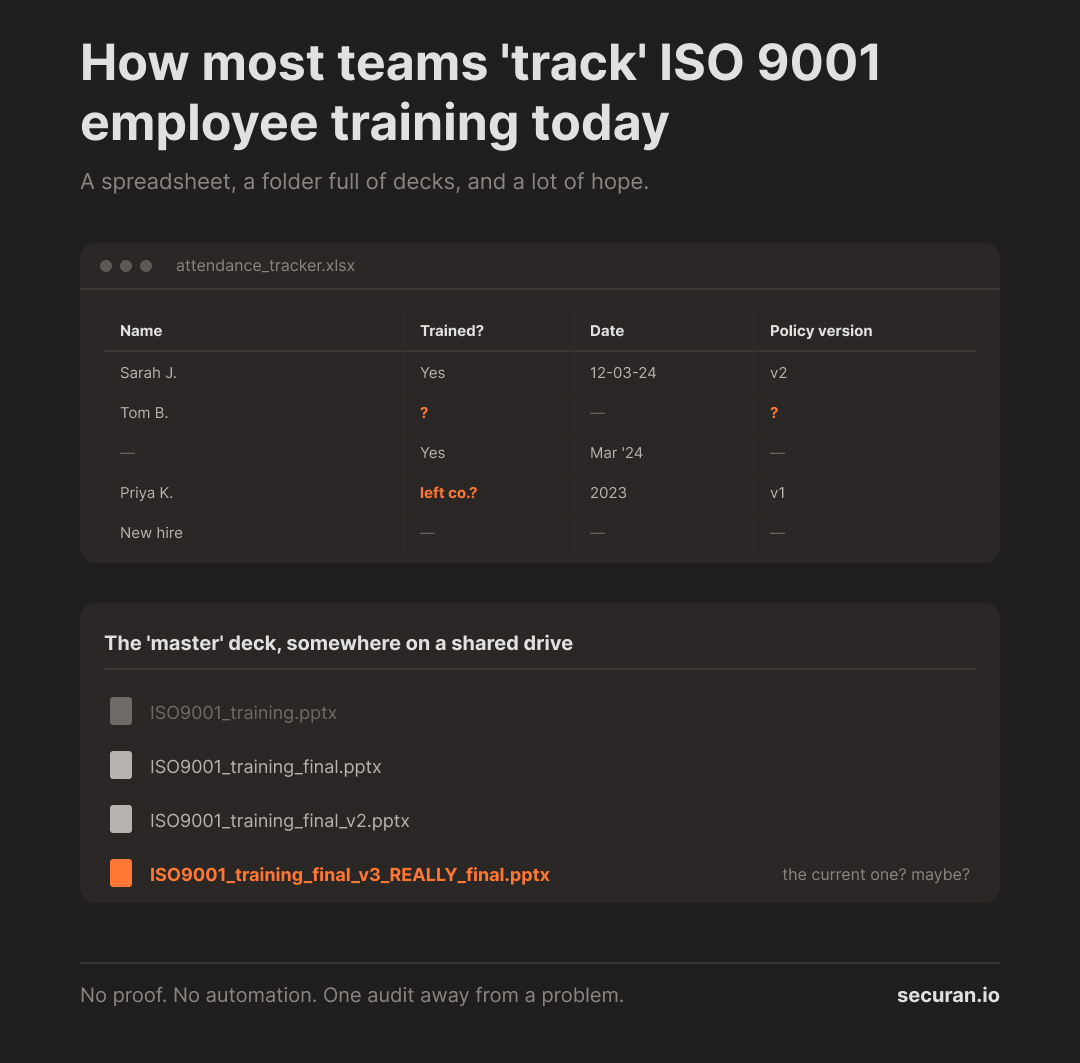
So most people patch that gap with a spreadsheet. A tab somewhere with names down the side, a date column, maybe a tick for "attended." It works, sort of, until you have to retrain half the company after a process change and then reconcile who did the old version, who did the new one, and who slipped through entirely. There's no automation behind any of it. Every update, every new hire, every refresher is another manual edit to a file nobody enjoys maintaining, and one fat-fingered row away from being wrong in front of an auditor.
This is a distinction people miss constantly. ISO 9001 separates awareness (7.3) from competence (7.2) on purpose.
Awareness is knowing the quality policy exists and roughly what it means for your job. Competence is being able to do the work to the required standard. Clicking through slides might produce a vague sense of awareness. It does nothing to demonstrate competence, because there's no point at which anyone has to show they understood anything.
No questions answered, no threshold passed, no result recorded. Just a room of people watching a slide advance.
Most downloadable ISO 9001 decks explain the standard in the abstract: here are the clauses, here's what a QMS is, here's continual improvement.
But 7.3 awareness is specific. It's about your quality policy, your relevant quality objectives, each person's contribution to the QMS, and the implications of not conforming. None of that lives in a template you found online. Your QMS is your documented processes, your SOPs, your policy. Training that never references those documents isn't really training on your system. It explains a standard without ever touching the thing that standard is supposed to govern.
ISO 9001 is built around continual improvement, so your documented information gets revised. Processes get updated after a corrective action. Quality objectives shift year to year.
Every time that happens, your deck is out of date. You can edit it, of course. Nobody's stopping you. But editing the slides is the easy part. The hard part is making sure everyone sees the corrected version and not an old one. Which file is current? The copy on the shared drive, the one in someone's inbox from last year, or the version a manager saved to their desktop and never updated? Without proper software, version control is you renaming files "training_final_v3_REALLY_final.pptx" and hoping the right one lands in front of the right people. There's no mechanism that flags "this changed, these people need retraining." You are the mechanism, and you're running it by hand.
A live session works for the people in the room that day. What about the five people who join next quarter? You either re-run the whole thing for them or email them the file and trust they'll read it. (They won't.)
Compliance isn't an annual event. It's an ongoing obligation that includes onboarding and refreshers. A one-time presentation treats a continuous process like a calendar entry.
Strip it back to what an auditor wants to see, and the requirements are simple. Training built on your actual QMS documents rather than generic content. A way to confirm people understood it, not just attended. A record of who completed what and when. A way to tie that record to the version of the policy or process they trained on. And a way to retrain people when something changes, with fresh evidence each time.
None of it is exotic. It's just that a PowerPoint delivers none of it. (If you want the full structure of a program that does, we wrote about that in how to build an ISO 9001 employee training program.)
The good news is that the work you put into your documentation isn't wasted. Your policies, SOPs, and quality manual are the raw material. You just need something that turns them into evidence without the PowerPoint step in the middle.
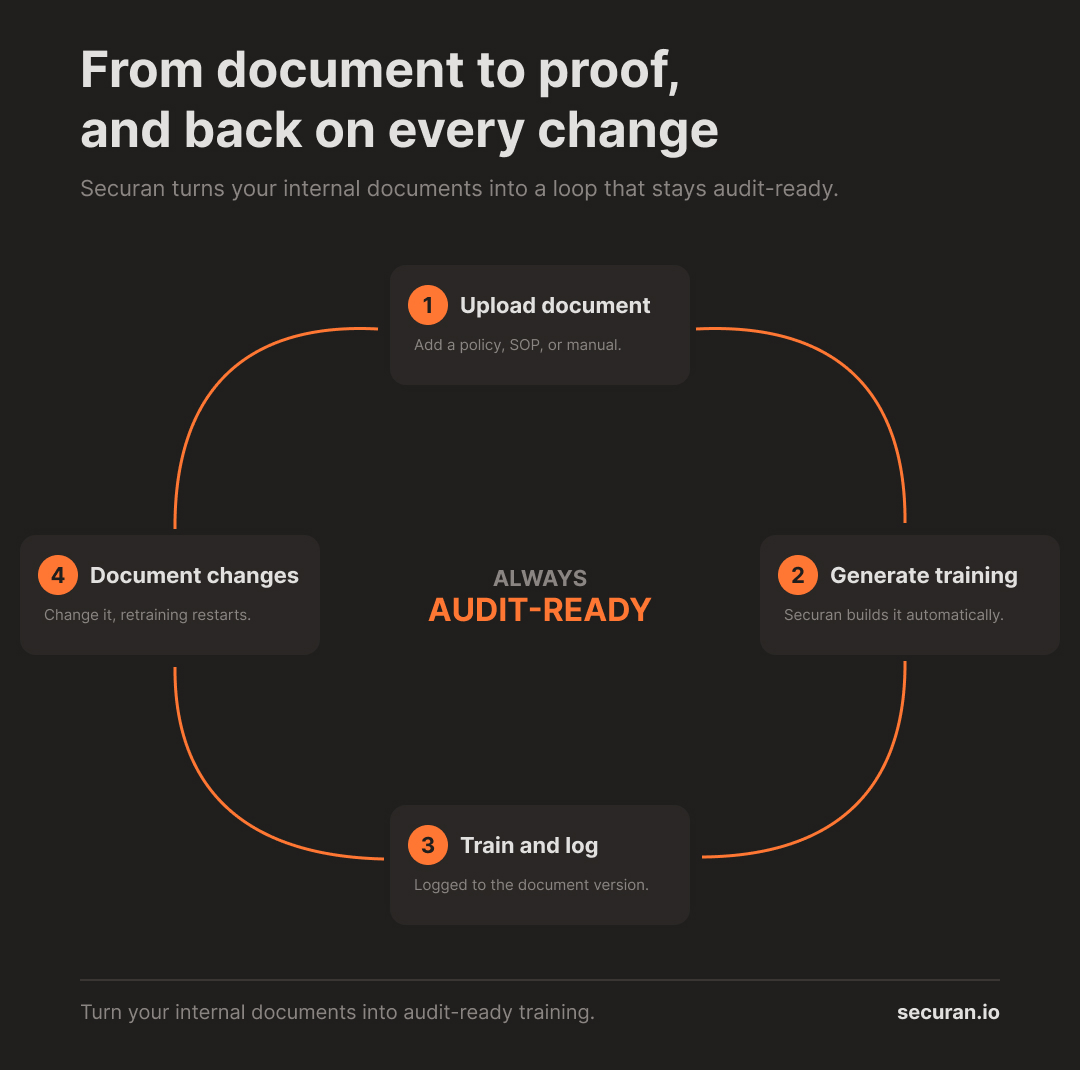
That's what Securan does. You feed in your internal documents directly. No building slides, no formatting a deck, no design work. The platform generates a complete training program from what you upload.
Employees complete it, answer questions that confirm they understood it, and every completion is logged against the document version they trained on.
When a document changes, you re-upload it and retraining is triggered automatically for the people it affects. You also decide per document whether training runs once or repeats on a schedule, so the things that need an annual refresher get one and the things that don't are left alone.
That's the difference between a deck you present and a record you can hand an auditor.

Create documented proof of understanding for audits.

Securan is a platform that turns your SOP into a training program for documented proof of understanding.


