
Turn your policy into training.
Create documented proof of understanding for audits.





If you're certifying to IATF 16949, you've probably already noticed that "awareness training" means something heavier here than it does anywhere else.
The standard expects employees to be aware of the quality policy and how they contribute to it, then stacks a list of automotive-specific demands on top, and then your customers stack their own demands on top of that.
There is no generic course that covers all of it. There can't be. A large part of what your people need to know is written in documents that only your company has.
This article walks through how to build IATF 16949 awareness training from your own internal documentation, why that's the only version that survives an audit, and how to do it without burning a month of someone's time.
Three things separate IATF awareness training from the generic kind.
The first is customer-specific requirements, or CSRs. On top of the standard itself, every OEM publishes its own set. Stellantis, Ford, General Motors, Honda, Toyota, and Daimler each maintain their own requirements that your training has to cover, separate from the base standard. If you supply more than one of them, you're managing several sets at once. A generic training library has never seen your customer's CSR file, so it can't train your people on something it doesn't have access to.
The second is that everything is production-specific. This isn't a broad management standard that could apply to a consultancy or a hospital. It's automotive manufacturing and nothing else. Awareness here isn't abstract. It's operators on the line knowing why a control plan exists, quality staff understanding the core tools (APQP, PPAP, FMEA, MSA, and SPC), and everyone understanding how their work feeds the part that ends up in a moving vehicle.
The third is audit pressure, and this is where the stakes get concrete. The IATF collects nonconformity data from its certification bodies and publishes the most common findings, and inadequate training and competency shows up repeatedly as a root cause behind the top nonconformities. The penalty isn't a polite note in a report either. A major nonconformity triggers automatic suspension of your IATF 16949 certificate. The distance between "we ran a session once" and "we can prove competence held up over time" is wide, and an auditor is paid to find it.
Before you build anything, get clear on the inputs. And understand that "training" in IATF isn't one requirement. It's a stack of them, sitting mostly in clause 7.
Clause 7.2 covers competence: identifying what each role needs to know and proving they know it. It breaks down further into on-the-job training for anyone moving into new or modified responsibilities (7.2.2), internal auditor competency (7.2.3), and second-party auditor competency (7.2.4). Clause 7.3 covers awareness: making sure people understand the quality policy, the objectives, and their own contribution to them.
Then there's the distinction the standard cares about most, and the one most programs get wrong. IATF separates training from competence. Training is the input. Competence is the result. The standard wants evidence of competence, not just a register showing who sat through a session. A signed attendance sheet proves someone was in the room. It doesn't prove they can run the process.
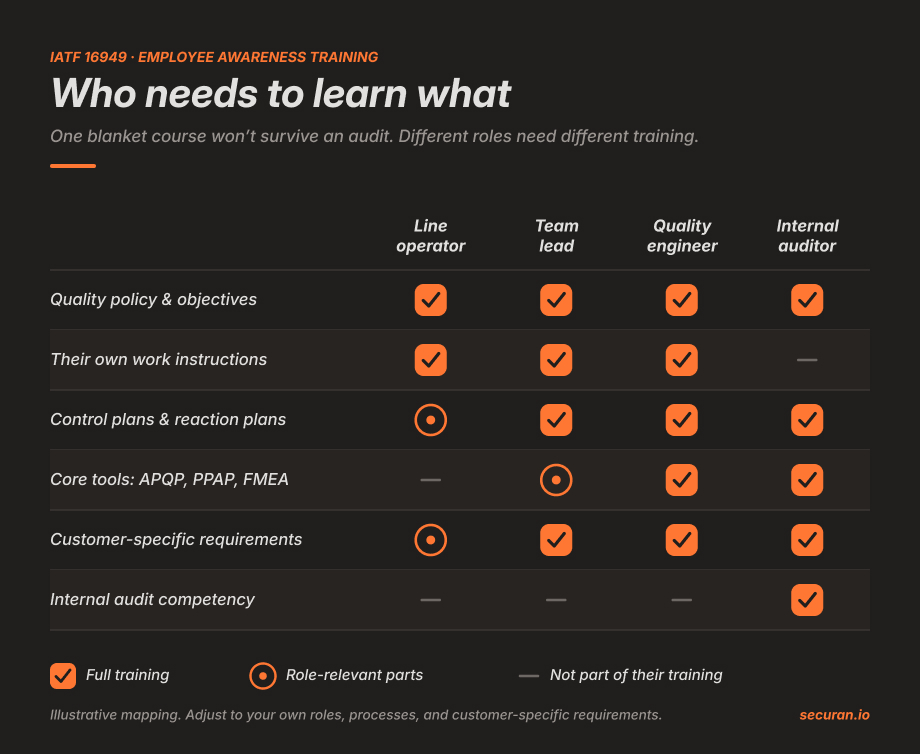
So your training has to pull from documents you already own:
That last point is where most programs fall short. An internally trained auditor, a line operator, and a quality engineer don't need the same training. One blanket course for the whole plant doesn't meet the standard, and an auditor will spot it in about five minutes.
Here's the part nobody mentions: you already have most of the content. It's sitting in your document control system. The job isn't writing training from scratch. It's turning what you've already documented into something your people can learn and you can prove they learned.
Two reasons.
First, it's the only version of awareness training that's actually true. Training built from your real procedures and your real customer requirements teaches people what they genuinely need to do. Generic training teaches them what some vendor decided the average manufacturer should know.
Second, it's the version that holds up. When an auditor asks how you ensure operators are competent on the current control plan, "we bought a training package" is not an answer. "Here's the role-based program built from that control plan, here's who completed it, here's the assessment they passed, and here's the retraining log from when we revised it in March" is an answer.
The catch is that the manual version of this is genuinely a lot of work. Maintaining a training matrix, rebuilding content every time a document changes, and chasing completion records across a plant is the kind of task that quietly eats a quality manager's month.
Doing all of this by hand is the part that doesn't scale. Securan is a compliance training platform that turns the documents you already have into role-based IATF 16949 awareness training, with the audit evidence attached. Here is what the five steps above look like when the platform does the work.
Pricing is a flat €100 per month, no matter how many people you train. No per-user fees, no annual contract. Cancel anytime.

Create documented proof of understanding for audits.

Securan is a platform that turns your SOP into a training program for documented proof of understanding.


