

Turn your policy into training.
Create documented proof of understanding for audits.





Organizations are rapidly moving away from generic compliance training libraries. With AI, it’s now possible to generate training yourself. So why spend all that money on expensive content libraries?
This guide compares five of the most relevant AI compliance training builders today, from AI-native tools to modern authoring platforms.
For years, compliance training has followed the same model: buy a library, assign courses, track completion.
That model is starting to break.
Most organizations already have internal policies, SOPs, and controls. Compliance training should be focused on ensuring that employees internalize what’s inside of those documents.
But in reality, most training is based on generic, one-size-fits-all content that simply can’t reflect all the nuances of each company’s policy.
That creates a gap: employees complete training, but not necessarily on the procedures they are expected to follow.
A developer, HR manager, and finance employee face very different risks and responsibilities. That’s why many directives require employees to receive role-based training.
Generic training libraries struggle to adapt to this. Manually creating and maintaining training content for every specific role within a company is simply too time-intensive.
AI-generated training, on the other hand, can dynamically adjust content based on role, context, and risk profile.
Many compliance training vendors now use AI internally to produce training content faster. Content is not being created by experts, at best, it gets checked by them.
But instead of exposing that capability, they still sell static course libraries at premium prices. The underlying value has shifted from content creation to distribution, but pricing hasn’t followed.
You have that policy sitting in the drawer. And it took you a lot of work to create. Why not use AI to turn it into training?
Traditional compliance training vendors aren’t cheap. And in the past, this made sense. It cost a lot of man hours to create:
But with AI, generating content becomes cheap. The real value that the vendors should add is:
There’s no reason why anyone should pay enterprise fees for AI-generated content.
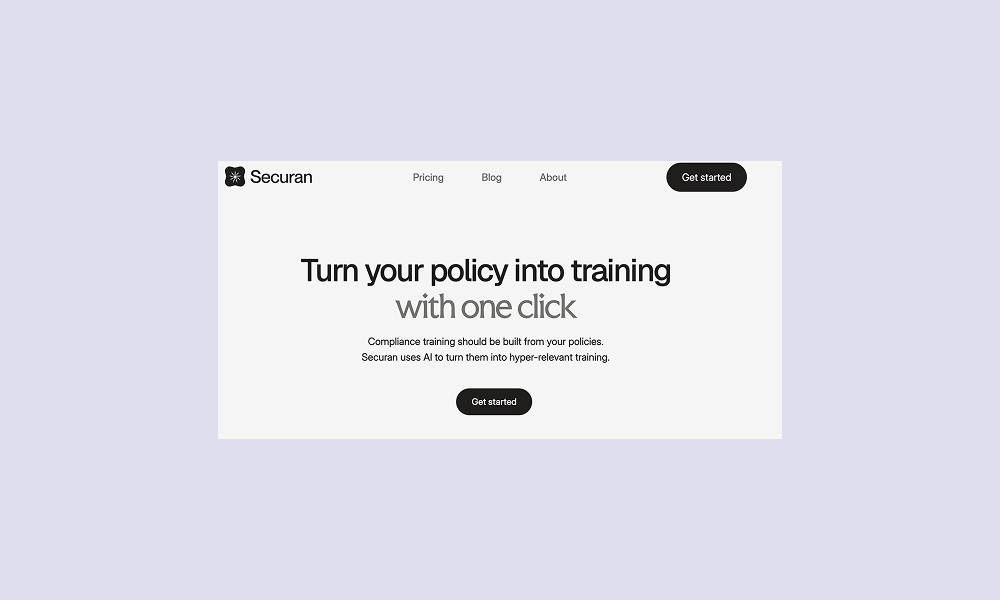
Securan is a platform that let’s you turn your policy into a training program in one click.
Instead of signing up your users for generic courses, you start with your policy or SOP.
Whenever a policy changes, you can simply reupload it, generate a new training program, and your users will automatically be prompted to retrain. The platform keeps track of participation and performance for compliance. It does so per policy.
Securan believes that compliance training should be affordable in the age of AI. That’s why it doesn’t come with user-based pricing, but a standard price per month. No matter how many users you add to the platform.
This makes Securan a straightforward and affordable, yet audit-proof solution for compliance training.
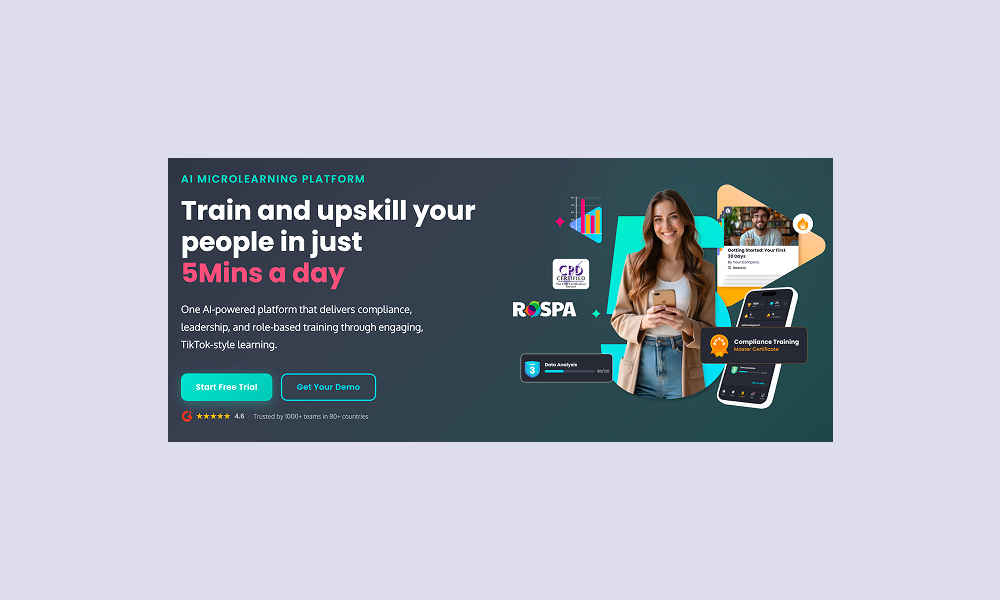
5mins.ai takes a different angle. Rather than positioning itself primarily as a compliance system, it focuses on making training content easier to consume.
The platform is built around short, bite-sized learning modules and uses AI to turn existing content into training. It also emphasizes role-based personalization, which is relevant for organizations that want to move away from assigning the same course to every employee regardless of job function.
That makes 5mins.ai particularly interesting for teams that already have content, but want to present it in a more engaging format. The platform also offers compliance libraries and content updates, which can reduce the manual work involved in keeping training material current.
Where 5mins.ai appears less focused is on the compliance management side of the equation. It is not clearly built around policy versioning, retraining triggered by policy changes, or audit-ready proof tied to specific documents and versions.
As a result, 5mins.ai is best understood as a strong training delivery layer. It helps organizations package and distribute content more effectively, but it is less explicitly built as a compliance control layer centered around internal policies.
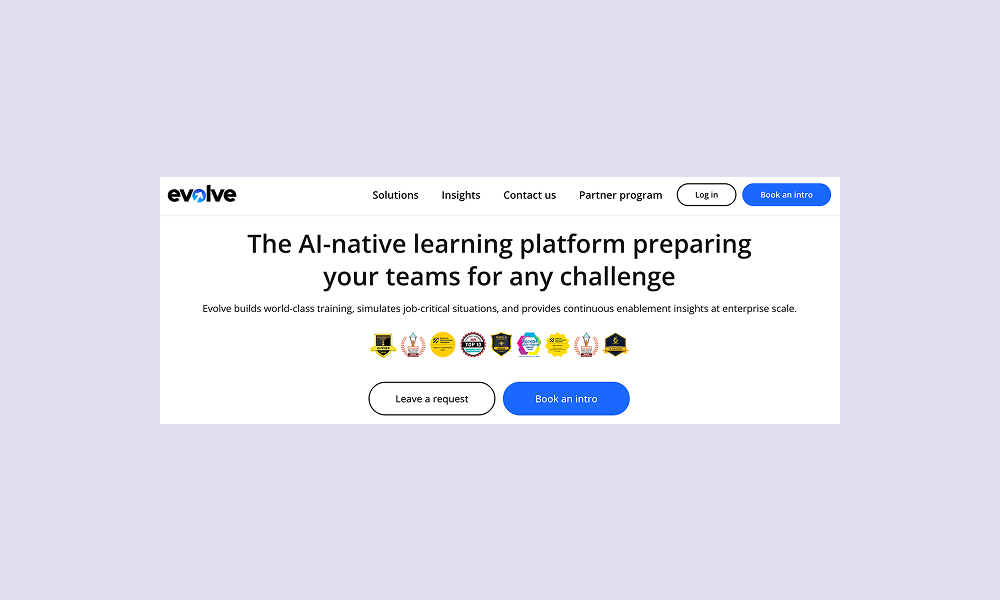
Evolve Platform is a broader and more enterprise-oriented learning platform with a strong emphasis on content creation. Its AI capabilities include course generation, and the platform also supports simulations and knowledge base functionality.
Compared to some of the other tools on this list, Evolve feels more configurable and more likely to be used in larger or more customized environments. That flexibility can be attractive for organizations with complex training needs or existing learning infrastructure.
At the same time, that flexibility usually comes with more implementation effort. Evolve is not positioned as a lightweight tool that simply turns a policy into a training program and handles the compliance workflow from there. It is better suited to organizations that are willing to configure a broader learning environment around their needs.
That distinction matters. While Evolve can support sophisticated learning programs, there is no especially clear focus on version-specific proof of training or automatic retraining tied to policy updates. In other words, it can be used for compliance training, but it is not narrowly built around compliance evidence in the way some buyers may be looking for.

TTMS AI4E-learning is one of the more direct examples of AI being used to turn source material into training content.
Its core appeal is straightforward: upload documents, generate training modules, and accelerate the authoring process. For teams that want to move faster and reduce the manual work of course creation, that is a compelling proposition.
In that sense, TTMS comes relatively close to the idea behind policy-driven training. It recognizes that organizations already have documentation and that AI can help transform those materials into something more usable for learning purposes.
The main limitation is that TTMS appears to remain an authoring tool first. It helps create content, but it is not primarily positioned as a platform for managing compliance over time. There is no strong emphasis on retraining workflows, audit evidence, or tracking compliance at the level of individual policy versions.
That makes TTMS a relevant option for organizations looking to speed up content production. But for those specifically looking for an end-to-end compliance training system, it may leave part of the problem unsolved.
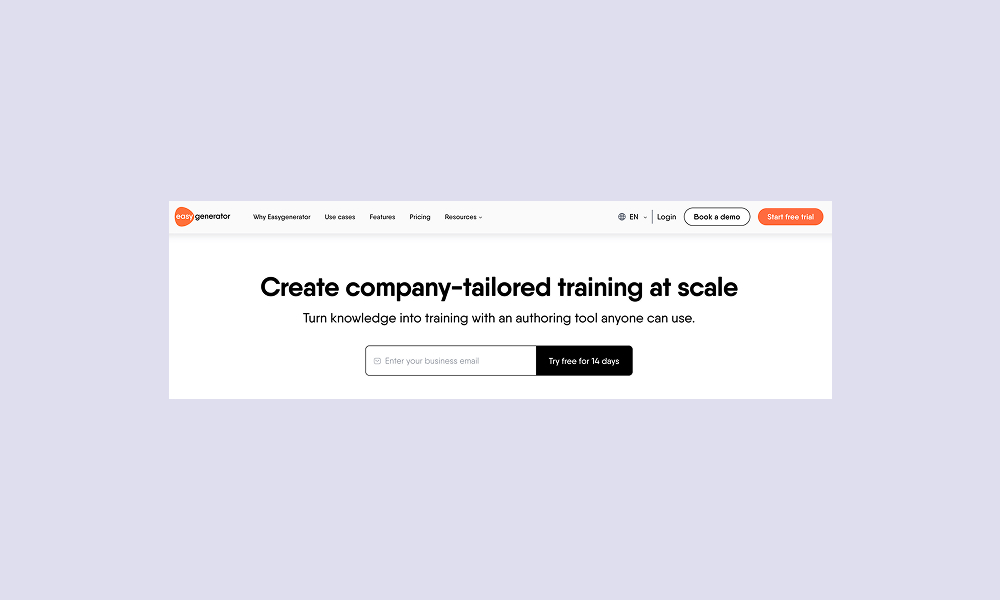
Easygenerator comes from a slightly different category again. It is best known as a cloud-based e-learning authoring tool that has recently added AI functionality to make course creation faster and more accessible.
Its strength lies in usability. Subject matter experts can create courses without needing deep instructional design experience, and the platform lowers the barrier further with AI-generated outlines, quiz suggestions, and image generation. Combined with templates, drag-and-drop editing, and collaborative review features, this makes it a practical tool for organizations that want more people involved in building training content.
That usability is important, because in many companies the people with the most relevant compliance knowledge are not professional course builders. Easygenerator makes it easier for those people to contribute directly.
Still, Easygenerator is fundamentally an authoring environment. It helps you create courses, but it does not appear to be built as a compliance system with native retraining logic, policy-based version control, or audit-proof evidence tied to specific policy updates. Delivery and reporting typically depend on the LMS the content is published to.
So while Easygenerator is a strong option for democratizing course creation, it is less suitable for organizations that want the training platform itself to act as a central compliance record.
The right tool depends less on feature lists and more on what problem you are actually trying to solve.
Some organizations mainly want to create training content faster. In that case, an AI authoring tool may already be enough. Others want to replace generic compliance libraries with training based on their own policies. That requires more than content generation alone. And some organizations need a system that not only delivers training, but also proves who completed which training, under which policy version, and whether retraining took place after a change.
That is why it helps to distinguish between three categories.
The first category is AI authoring tools. These help create courses faster, but usually depend on another system for delivery, tracking, and compliance reporting.
The second category is training delivery platforms. These are strong at making content engaging and easy to roll out, but are not always designed around policy lifecycle management.
The third category is compliance-focused systems. These start with the policy itself and treat training as part of a broader compliance workflow that includes retraining, evidence, and auditability.
The key question, then, is not which platform has the most AI features. It is whether you are looking for a better way to create courses, a better way to deliver them, or a better way to manage compliance.
AI is changing compliance training in a fairly fundamental way.
For a long time, organizations had little choice but to buy generic libraries or spend a large amount of time creating custom training manually. That made compliance training expensive, slow to update, and often only loosely connected to the policies employees were actually supposed to follow.
Today, AI makes creating a compliance training program easy.
If you’re looking for an AI compliance training builder that’s affordable, easy to manage, and offers version-specific insights for audits, consider using Securan.

Create documented proof of understanding for audits.

Securan is a platform that turns your SOP into a training program for documented proof of understanding.


