

Turn your policy into training.
Create documented proof of understanding for audits.





If you're working toward ISO 9001 certification, or trying to hold on to it, you've probably already figured out that employee training is non-negotiable. Auditors want to see that your people understand the quality procedures they're supposed to follow. Not just that they sat through a generic video about quality management.
This article covers what ISO 9001 actually requires on training, what a program that satisfies those requirements looks like in practice, and how to build one without it becoming a massive project.
ISO 9001:2015 addresses employee training primarily through clause 7.2 (Competence) and clause 7.3 (Awareness).
Clause 7.2 requires your organization to determine what competencies are needed for roles that affect quality, ensure those people are competent, and keep documented evidence of it. The standard doesn't tell you how to train people. It tells you to prove that the people doing the work know what they're doing.
Clause 7.3 requires that employees are aware of the quality policy, the quality objectives relevant to their role, and how their work contributes to the quality management system. Again: no prescription on format, but a clear requirement to demonstrate awareness.
To understand what training needs to cover, it helps to know how ISO 9001 documentation is typically structured. There are two layers.
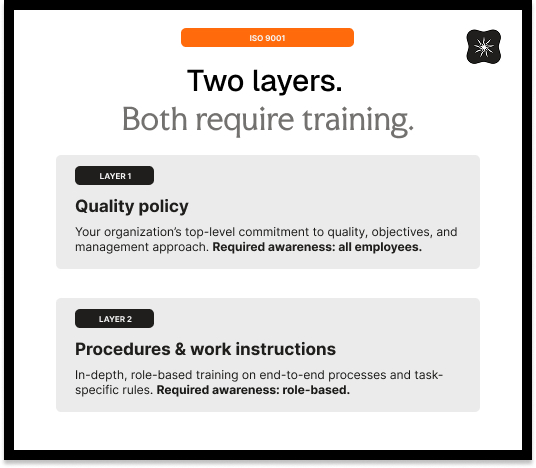
The first is your quality policy: a high-level statement of your organization's commitment to quality, objectives, and the overall management system. Every employee needs to be aware of this.
The second layer is where most of the training work lives: the procedures and work instructions that describe how things actually get done. A procedure covers a process end-to-end (think: complaint handling, supplier evaluation, document control). A work instruction goes one level deeper — task-specific guidance for the person actually doing the work.
This is exactly why off-the-shelf training doesn't work for ISO 9001. No vendor has a library of your complaint handling procedure or your production work instructions. That content only exists inside your organization. Training has to be built from your own documentation.
This is where it gets concrete. The standard gives you flexibility on format, but auditors have clear expectations on substance.
The first thing auditors check under clause 7.2 is records. You need to keep documented evidence of who was trained, what they were trained in, and when the training took place. That sounds simple, but it's one of the most common places organizations fall short. Competence record gaps under clause 7.2 are among the most frequently cited nonconformities in ISO 9001 audits.
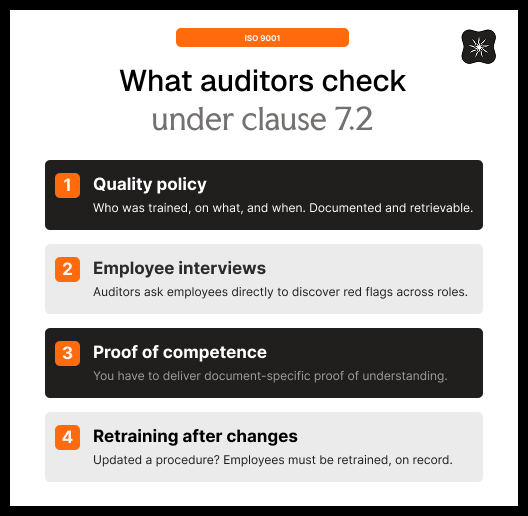
The second thing auditors will do is test your employees directly. Auditors will often ask multiple employees for the same procedure — inconsistency is a red flag. If your warehouse manager and your production lead describe the same process in completely different ways, that's a finding waiting to happen, regardless of what your training records say.
Third, training records alone are not enough. Training alone is not sufficient to demonstrate competence — it must be demonstrated through tests, observations, results, or similar evidence. That means your program should include some form of verification: a quiz, a sign-off, a practical check. Attendance alone doesn't prove understanding.
Fourth, retraining after procedure changes matters. If your quality procedures are updated and employees weren't retrained on the new version, that's a gap. Auditors look for evidence that your training program is a living process, not a one-time event.
In terms of content, a solid ISO 9001 training program covers all three document layers:
Not every employee needs to be trained on every procedure. A finance employee doesn't need your production work instructions. Role-based training is both more practical and more defensible in an audit.
The last point matters more than people expect. Clause 7.3 specifically requires employees to understand how their work contributes to the quality management system. An auditor can and will ask a shop floor employee what quality means in their job. If the answer is a blank stare, that's a clause 7.3 finding.
Because the training has to be based on your internal procedures, you're building this from scratch. There's no shortcut around that. The question is just how painful the process needs to be.
The classic approach. You sit down, open PowerPoint, and start turning your quality manual into slides. Someone in HR or ops spends a few days on it. You host a session, track attendance in a spreadsheet, and file it away until the next audit.
This works to a degree and it’s obviously the most cost-effective method. But there are multiple obvious downsides:
For a 10-person company with one quality process, this method is somewhat manageable. For anything bigger, it becomes a recurring manual burden with no reliable audit trail.
You could bring in a consultant or instructional designer to build out your training program. They'll interview your team, map your procedures, and produce something professional.
Some compliance agencies that help you build your policies and procedures offer this service. But these consultants often use method number one to do it themselves for an hourly rate that is usually pretty high.
In short, this is expensive and slow. And when your procedures change six months later, you're either back on the phone with the consultant or maintaining content you don't know how to update. The output is also typically a static document or SCORM file that lives somewhere in a shared drive and doesn't track anything on its own.
The more practical, modern approach is to use a compliance training builder like Securan that turns your existing ISO documentation into training automatically.
You upload your quality policy, procedures, or work instructions, and the platform generates a complete training program from them. Because you're starting from your own documents, employees get trained on your actual processes, scoped to their role. A customer service employee gets trained on the complaint handling procedure. A warehouse operative gets trained on the relevant work instructions. Not the same generic module pushed to everyone.
When a document changes, you upload the new version and generate an updated program. Employees who need to retrain are prompted automatically. Every completion is logged and tied to the specific document version, so you have clean audit evidence without managing a spreadsheet.
That last part is what closes the loop on clause 7.2. Not just that training happened, but that you can show who completed which training, under which version of a procedure, and when.
ISO 9001 employee training is one of those requirements that sounds simple until you're actually responsible for it. The content has to reflect your internal documents, the records have to be clean, and it has to stay current every time something in your quality system changes.
Building that manually is possible, but it tends to become someone's ongoing side project with a high chance of gaps showing up exactly when an auditor asks.
Securan is a platform that lets you generate a compliance training program based on your specific internal documents. Invite your employees, collect training evidence, and prove compliance during audits. Flat €100 per month, no matter how many users you have. Cancel any time.

Create documented proof of understanding for audits.

Securan is a platform that turns your SOP into a training program for documented proof of understanding.


